
Paul Newman CBE: We are building the next Waymo of industrial autonomy


Originally published by IZON, and republished with permission.
Oxa CEO Paul Newman says industrial mobile autonomy is "utterly inevitable". In this exclusive interview, he explains why he's been obsessed with robots since the age of five, how he helped pioneer modern autonomy, what Oxa got wrong first time round, and why he thinks the UK is still too slow to adopt the technology.
“Look around the room you’re in. Can you see anything that was not towed?” Paul Newman asks.
His point is that almost everything we see around us has been towed through a yard, airport or shipping port to get to us.
“The act of towing is the hidden arterial system of global trade,” he continues. “No kidding. We move stuff, and as we move stuff, it’s towed, and it’s towed by lots of different kinds of vehicles. This is why I am absolutely convinced that industrial mobile autonomy is utterly inevitable.”
Newman, 53, is the co-founder and chief executive of Oxa. He is a roboticist, entrepreneur, Oxford professor and widely seen as one of the godfathers of UK autonomous driving. He has worked on autonomy since 1995 and spun Oxbotica, now Oxa, out of Oxford University in 2014. After securing a major automotive supply contract, which was later cancelled when the OEM was unable to complete its vehicle programme, the company refocused on industrial mobile autonomy (IMA): driverless vehicles moving containers, baggage and freight around ports, airports and large industrial complexes.
Oxa raised $103 million in March, is talking to investors about topping that up, and has recently signed a joint venture in Dubai that Newman says will deliver its first fully driverless commercial rollout.
IZON: Paul, could you introduce yourself and tell us how you got involved in this space?
Paul Newman: I’m a roboticist. I guess I’m one of the OGs of autonomy, going back to 1995. I’m a professor, an entrepreneur and I advise the government where appropriate.
I’ve spent my whole career building what we used to call robots and now call physical AI. That has ranged from subsea vehicles, some of which are operational in the Strait of Hormuz right now, to systems qualified for Mars, to mines, trucks and vehicles carrying people around streets. The common theme is mobile autonomy. There is something epically cool about making 100-ton machines work through software and AI.
Was this a lifelong passion?
All through my childhood I was trying to build machines that did things. I remember when I was about five, my old man came back from London with a little felt-covered electric dog that would sit, walk and bark. I was just mesmerised by it and on day one my mum comes into the kitchen and screams because I’ve skinned it, taking all of its fur off to see how it worked. My parents were like ‘is there something wrong with the child?’ And my father was like ‘no, it looks like he’s got engineering-itis.’
There’s something about the thrill of physical AI where if you screw it up, you’re going to know in about three seconds. A great example of this is when I worked on autonomous underwater vehicles [AUVs] where you press a button, D for dive, and you’re not going to see it again for three hours. You can’t talk to it. It’s gone, under the water somewhere, no comms, no ethernet. Three years of work has gone into that. Have you thought it all through? You hope you gave it the right coordinates, else you’ll never see it again, and I think trying to bring those systems together is an addiction.
What did you pioneer before founding Oxbotica in 2014?
A group of us in the late nineties got hooked on a class of algorithm called SLAM, which lets a machine build a model of its world and know where it is. I remember it was March 16 1996 and I was a PhD student in Sydney standing on one side of the Parramatta Road when a student who was just finishing his asked whether a machine could ever know where it is? I heard that as ‘can machines never get lost and always know what to do’. I thought that sounds like a great problem and I’ve been addicted to it ever since.
Where am I, what’s around me, what should I do next? That is a great description of what physical AI needs to do. I worked on some of the foundational principles of SLAM and was able to build machines that used it. And then I sort of carried that work forward into doing this large scale with some fabulous PhD students of mine like Mark Cummins. Since then it’s sort of careered off into different areas such as forms of perception, scene understanding, scene reconstruction, planning, using overhead images to understand what’s going on. This all led to Oxa.
How was Oxa formed?
When I was at Oxford I built a big research group, became the statutory chair of information engineering and launched the Oxford Robotics Institute. Then my colleague Ingmar Posner said ‘Look, we should spin Oxbotica out. We’ve got 10 years of work from inside the university. Let’s do it, right?’ And we started the business, and that was an extraordinary thing to try and do and build here in the UK. And I’ve loved the majority of all the minutes.
What was your original founding vision for the company, and how has this changed?
Okay, yeah this is going to be great fun because being a good founder means starting off with an idea and then it will be interesting to see what remains.
The founding vision was that the driving task is largely common across all kinds of driving. We called it universal autonomy. Oxbotica would be a pure self-driving software play, selling software to the people making vehicles for roads, mines and airports. Reflecting on this now, some of that survives, but also wow was some of that not the right thing to do.
You were appointed CEO in March. How has that vision changed?
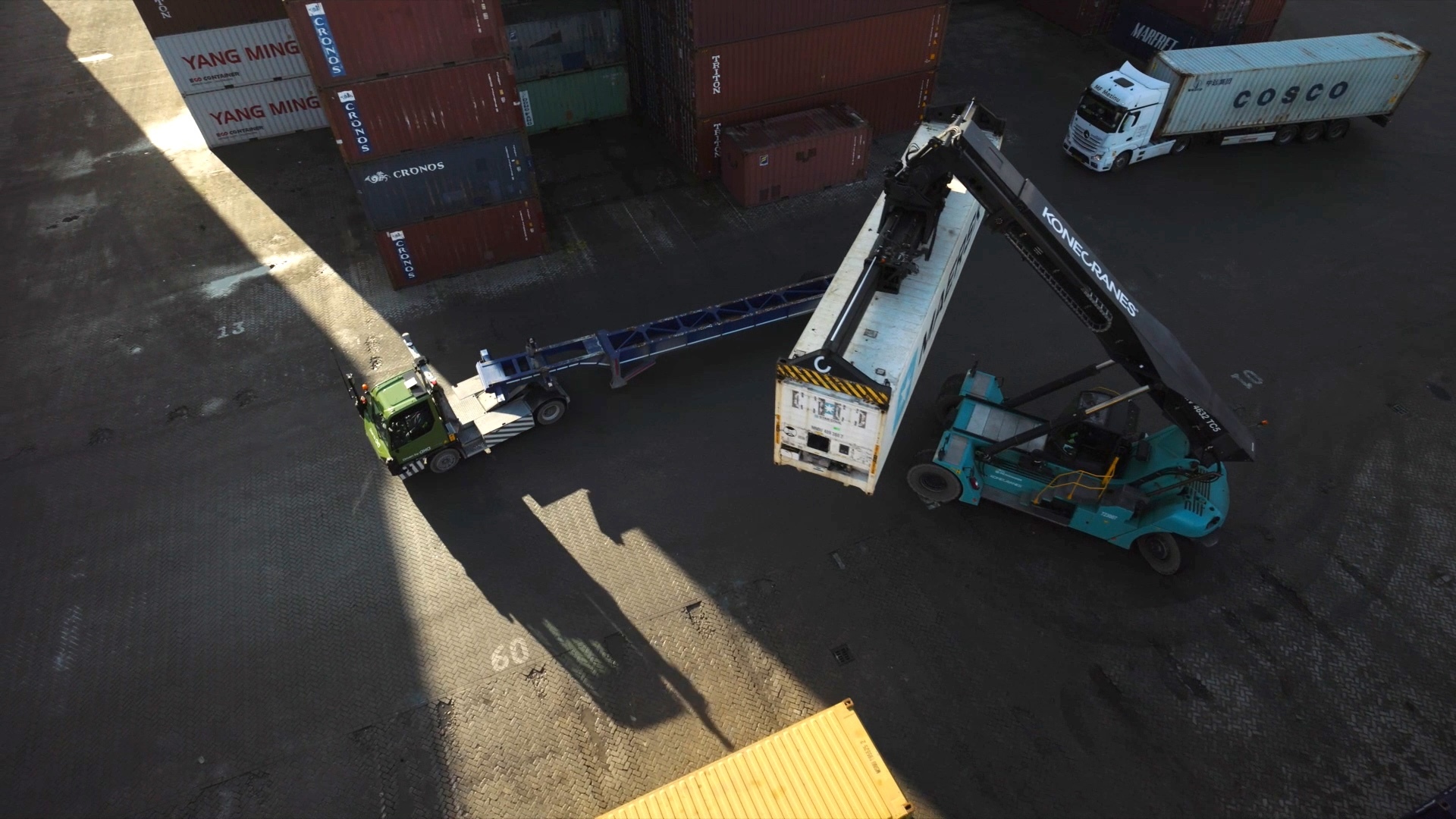
Now we’re all about industrial mobile autonomy. Almost everything that we interact in our daily life was towed through a yard, airport or port. About 90% of goods go by sea, and 60% of those go in those little boxes.
Oxa has been going for 12 years. Why are we only now seeing the first full-scale operation?
We did run a two-and-a-half-year full operation of around 20 autonomous shuttles in Florida with Beep, carrying unvetted passengers. So this was sort of our first commercial operation.
But, this is really interesting because before that, around 2019, we won a supply contract with a very big automotive company. We had the whole business writing that software for this supply contract and spent three-and-a-half years developing it. To your question, why did it take so long? This is exactly what I’m saying don’t do, which is writing software to supply someone else’s product. They couldn’t complete the product, right? There was something about the chassis that they couldn’t solve and they cancelled the programme. That closed our route to market. It was one hell of a learning. Putting all your AV tech far upstream in the automotive industry means they can just change their mind.
So we turned it around. You can only do this in the industrial domain, where you don’t have to interfere with how the vehicle is built. Our solution bolts on to what the OEM makes. For the big trucks it’s about 30 bolts and four hours. It used to take us ten months. Now it’s a morning’s work.
So it’s retrofitted?
Yes, we call them chapels and spires. The chapel is the compute box which sits outside of the vehicle with its own cooling, and then there are a bunch of spires which have different sensors to give us the safety certification you need.
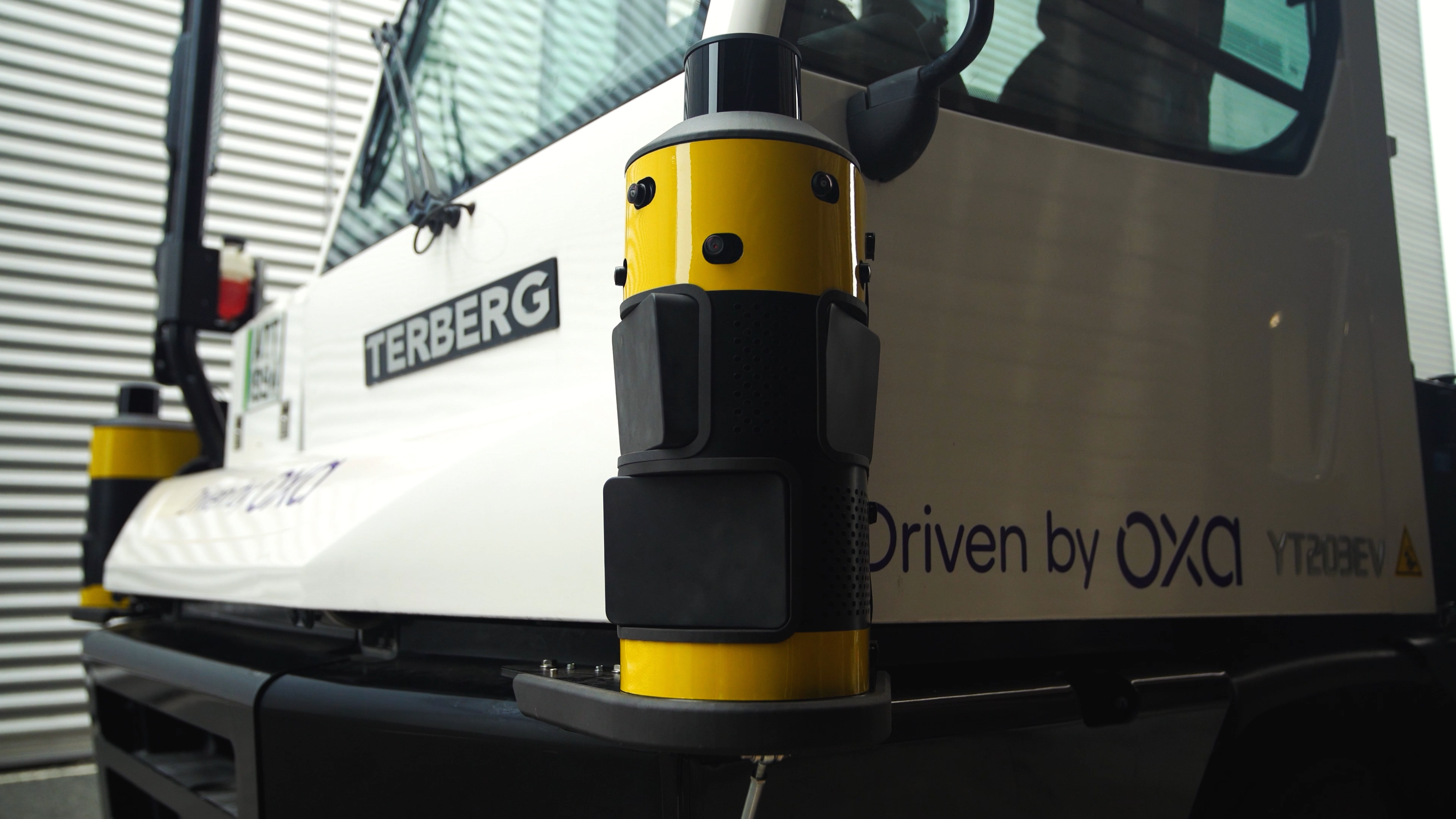
A unit called a “Spire” is fitted to each vehicle and contains sensors that allow it to survey its surroundings.
Where will the first full-scale rollout be and what will this look like?
It will be in the UAE. It will be the first fully working IMA rollout with zero occupancy and no safety drivers, on tens of trucks pulling shipping containers around ports. This will move up into the many hundreds. Now the nice thing about this is, I can’t tell you the costs, but the revenue and profit you make per vehicle is many orders of magnitudes higher than you could make per vehicle if you were doing this on-road. So we don’t have to have millions of vehicles to be unbelievably profitable.
In terms of the progress, the first vehicles have shipped. We signed a joint venture with the Dubai Future Foundation (DFF), which fits their sovereign autonomy strategy, D33. It’s called SHIFFT because it’s a shift of work, we’re shifting stuff and it’s a shift of gears, and a double F for DFF.
From there, we’ll be exporting the technology. SHIFFT will hire about 120 engineers to supply logistics and autonomy solutions to ports and airports. It took about two years to negotiate, which is about right. And that’s also our business model in that there is a channel partner. We don’t want to run airports. We want a channel partner that takes our technology and maps it directly to what customers need, not unlike an Nvidia model.
Turning to the UK market. Gavin Jackson, the former CEO of Oxa, said last September that the UK was having a Goldilocks moment in that conditions were just right for scaling companies like Oxa into global players. Is that still the case?
Look, I’m pathologically positive. That’s what people say of me. It’s pretty cool to hear the prime minister talk about reindustrialising the nation. The National Wealth Fund has also put £200 million into the UK’s ports. Yes, we’re an island. Yes, let’s get our ports using the latest and greatest technology that UK companies can supply. Let’s get our airports using the technology that’s sitting right here.
I can’t remember a business operator saying no when I ask, ‘Would it be cool if the machines drove themselves so your staff can do other things?’ They all say ‘yes, that would be economically impactful’. The case is made. I don’t hear that about on-road autonomy. There’s also an 11% shortage of drivers in industrial settings. So in that sense, I still violently agree with Gavin. The need is getting more acute. And I’m proud that we built it here and now export it to the world.
I sense there’s a huge but coming though…
What I want to be able to do is substantive deployments in the UK’s ports and airports. There is something coming around one of those soon. I want to reach the CFOs of businesses around the UK and go, ‘dear God, it’s right here, it’s right here. Work with me and partner with us.’
You must have been talking to UK companies for years though. What’s going on?
Well we have something called the Autonomy Transformation Program, or ATP. People say they know autonomy is huge and don’t know where to start. We aren’t asking them to order 4,000 vehicles. We work through their industrial processes, how they move things, the constraints and the ROI. Maybe a vehicle you only use on a Friday isn’t the one to automate. The one you want is the one you use constantly and worry about running out of drivers for. Earlier in Oxa’s history we were too focused on unit sales of vehicles. Now we say it’s inevitable, so we give you the path to that inevitability and take you from zero to hero in using autonomy.
When I was in China a couple of weeks ago, the culture among AV businesses and users was: we know it’s coming, so we don’t want to be a taker of it, we want to be a partaker in it. They co-install it into their workflow. It’s like the first computers. They didn’t just arrive on a desk. There was a programme for how to use them for accounting etc. Look, there was a time when I was downright frustrated that the UK was lagging behind in uptake and being a second mover. But now we have a methodology for doing this and hopefully we can get a lot more traction.
How do you compare IMA to robotaxis, and why did you step away from the road?
We moved away deliberately, and it’s one of the best decisions I made. I championed on-road autonomy for 14 years and I still do. But when you chase the economics, there are real challenges.
You have to interfere with a very complicated supply chain, where it takes four, five, six years to change what an OEM makes. The margins are small. How much would you pay per year for a fancy ADAS? Not a lot. It’s also enormously expensive. Look at the money Waymo has needed to raise. And it’s not always clear whose OpEx is crushed, or that citizens even want it.
As CEO I had to choose where there is a lot of money to be made, where you can make a big difference to world trade, where people want it and where our technology is suited. Because we’ve been working across vehicle types and sites at the same time, Oxa was particularly suited to industrial.
But the most important thing that totally solidified IMA was regulation. There was no regulatory certainty on road. I was very much involved in helping different parts of the regulatory system consider what the UK’s Automated Vehicles Act should be and what it should not be, but there wasn’t any certainty on that.
Is there regulatory certainty with IMA?
Yes, the EU’s machinery regulations set out what is required for a machine to be deemed safe and the UK has said it will align with those rules.
One thing that makes it happen now is regulatory approval through CE marking. You can’t sell a robot without it. It’s illegal. Since the move to IMA our world has become simpler because it’s one standard. It’s hard, but I can read it and form an architecture that makes the numerical arguments for why we pass that standard.
How many robotics founders and CEOs do you speak to who say the big thing they’re working on is CE marking? Not many. That’s why I think we’re ahead. How are you going to say your humanoid won’t hurt a three-year-old? We’ve done lots of proofs of concept and trials. But if someone asks to place an order, the answer has to be no until you have CE marking, or your OEMs have type-approved the vehicle, or you do a Waymo and pay for the fleet yourself. There are structural reasons why you can’t just sell it, even if the software works. Right now, 60 to 70% of our engineers are working on CE marking the architecture, and we’ll duplicate that across vehicle types.
So it’s the number one business priority.
Yes.
You raised $103 million in March. Where is the money being spent, and has the plan changed?
No, I’ve doubled down on it exactly. The analysis and understanding of the ROI from the customer perspective is extraordinary and almost overwhelming in its inevitability.
We’re investing in our product. We’ve drastically cut the bill of materials, so the CapEx per vehicle is down, and we’ve drastically reduced the installation time. The CE-marked architecture is quite different from a year ago, particularly around redundancy. You can’t have one big model or algorithm that says what to do. You need independent data paths, independent algorithms and sensor redundancy. And then we’ve been extremely focused on our business development strategy.
Look, we know the autonomy works. This is about building the next Waymo of IMA, and about how you build that out of the UK. That’s what I intend to do. I intend to build the next Waymo, but in IMA.
Is another funding round coming?
Yes, we’re always looking for the next round. The success of the IMA story means we’re talking to some investors about topping up the March investment.
How much are you looking for?
I can’t say.
Finally, do you think Oxa may return to the road in the future?
We may very well come back. We haven’t changed anything about our architecture that says it won’t work on roads. We just want to get the regulatory approval and tens of millions of miles in mixed industrial environments under our belt first. This is the mission.
This interview has been edited for clarity and length.


